For wide nail beds, verify the maximum usable width and the number of matching pieces first. Then confirm curvature and comfort with a dry fit.
Identify which fingers need extra width
Your thumbs may need a wider range while your other fingers fit ordinary sizes. Record the widest point of each nail separately, following the measuring method supplied with the set. PRESSE, for example, instructs users to measure across the widest part and compare millimeters with its own chart. Keep the method with your measurements so you can repeat it consistently.
If a chart does not explain whether its width follows the curve or runs straight across, ask before comparing numbers. An across-the-curve measurement and a straight-line measurement are different quantities. Neither a photo of large hands nor a previous size number resolves that uncertainty.
Read the largest sizes and their quantities
Check the chart for the exact shape and product line. Glamnetic publishes separate dimension tables for different styles, illustrating why one brand-wide size assumption is unreliable. Look for the largest available width, the neighboring widths, and how many pieces come in each size.
For an illustrative example, a nail measured at 16 mm cannot be matched by a chart that tops out at 14.5 mm when both measurements use the same method. Choosing a longer nail does not change that width limitation. Likewise, finding one suitable thumb cover is insufficient if you need two and the box supplies only one.
| Detail to verify | Why it matters for wide nails |
|---|---|
| Largest width in millimeters | Shows whether the range reaches your widest finger |
| Adjacent large sizes | Provides alternatives for fingers with different widths |
| Pieces per size | Confirms that both hands can be covered |
| Shape-specific chart | Avoids transferring a size between different molds |
Finding a press-on nail for a wide thumb
Check the left and right thumb separately before deciding that both need the largest cover. Their widths or profiles may differ. Record the exact product line, each thumb’s measurement, the matching size code, and the dry-fit result. Use the maker’s measuring method so the chart and your notes describe the same dimension.
If both thumbs use the same size, confirm that the selected pack contains at least two usable pieces of that size. A spare for a later replacement is an additional piece; a high total nail count does not establish how many of the widest size you receive. Ask about the size distribution or a matching replacement before ordering if it is not published.
A wide thumb can still have a shallow or a pronounced arch. If the largest cover reaches the sides but rocks or pinches, compare its curve instead of choosing more glue. If it leaves natural nail exposed along the sides, filing it cannot add width. A sample from a different range or a custom-size discussion is the next useful check.
Separate a width problem from a curve problem
During a dry fit, exposed natural nail along both sides suggests insufficient coverage. A cover that reaches both sides but leaves a central gap or needs squeezing may have an unsuitable curve. A wide nail bed can be flat or curved; these are independent fit characteristics.
Compare nearby sizes without adhesive. Note whether each candidate leaves exposed edges, overlaps skin, or sits comfortably. If increasing width replaces exposed edges with skin overlap while the gap remains, investigate the profile instead of continuing upward through sizes. A sizing sample can reveal this before you choose a finished design.
Know when the size range has reached its limit
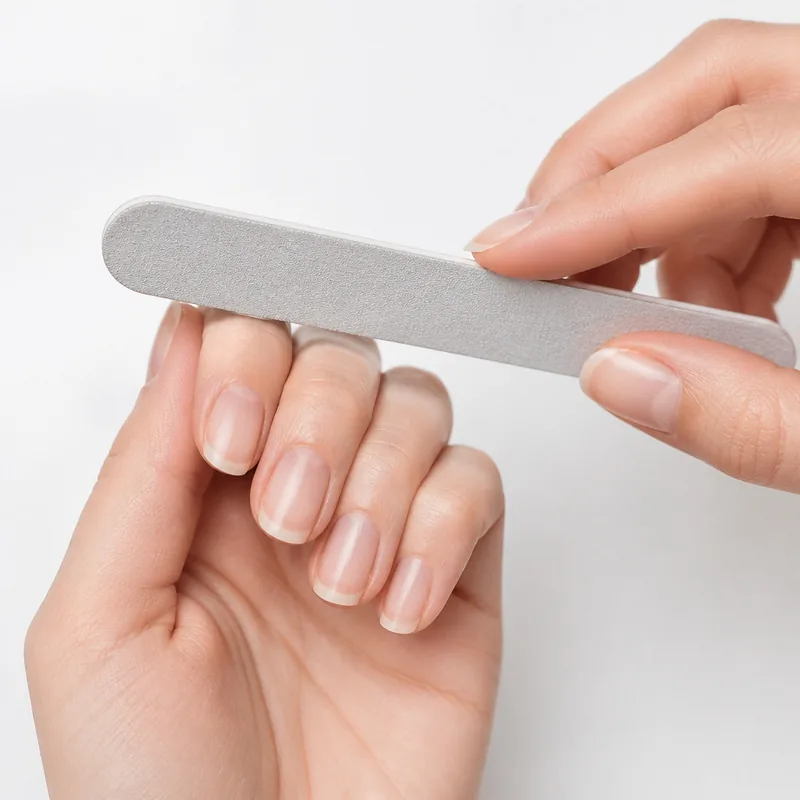
A cover that is too narrow cannot be made wider by filing. Doonails explicitly distinguishes this from reducing an oversized cover. When no size covers the nail comfortably, compare another documented width range or ask about a custom sizing option. Do not squeeze a small cover into position or compensate with extra adhesive.
Save the exact style, measurements, and result for each finger. This creates a useful comparison record when a manufacturer changes its molds. Follow product warnings and leave damaged nails uncovered; the American Academy of Dermatology warns that artificial coverage can worsen existing nail problems.
A few common questions
What size press-on nails fit wide thumbs?
There is no universal thumb size number. Measure and dry-fit each thumb separately, then confirm that the exact pack supplies enough pieces in the sizes you need. A wide label or large total nail count cannot establish that.
Are long press-on nails wider?
Length does not establish width. Check both dimensions for the actual style; a longer cover can still be too narrow.
Does a wide-fit label guarantee a complete fit?
No. Verify the measurements, curvature, and quantities for all ten fingers, including any repeated sizes you need.
Sources & reading notes
This guide explains general considerations. Product labels and instructions vary, so check the specific kit and adhesive you use.
Get to know Kittiva.
Explore the designs and kit details on the brand’s own website. Check current contents and delivery availability before choosing.
Read our Kittiva spotlightThis editorial project supports Kittiva.