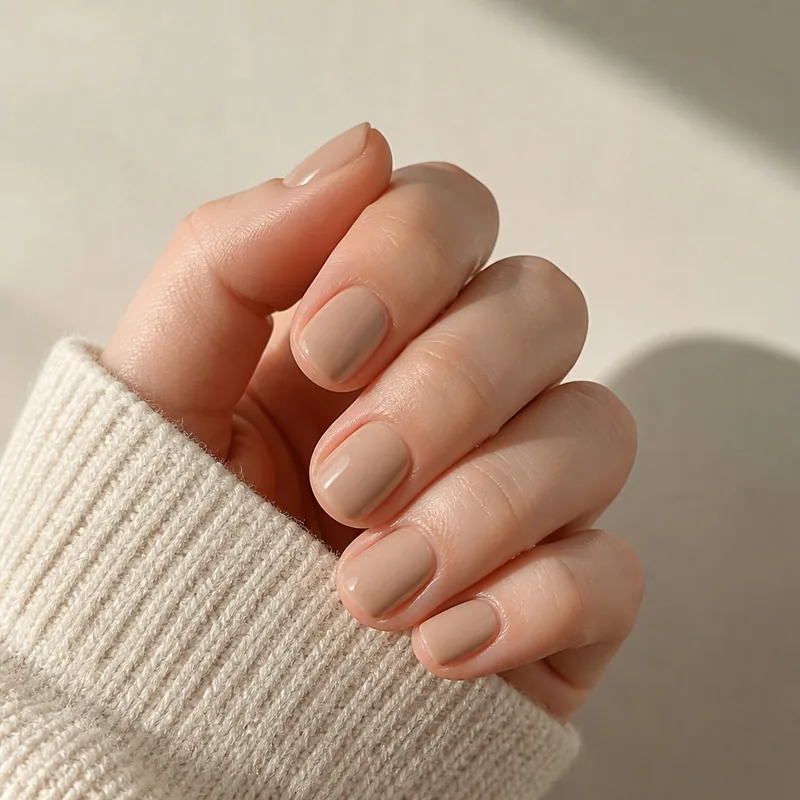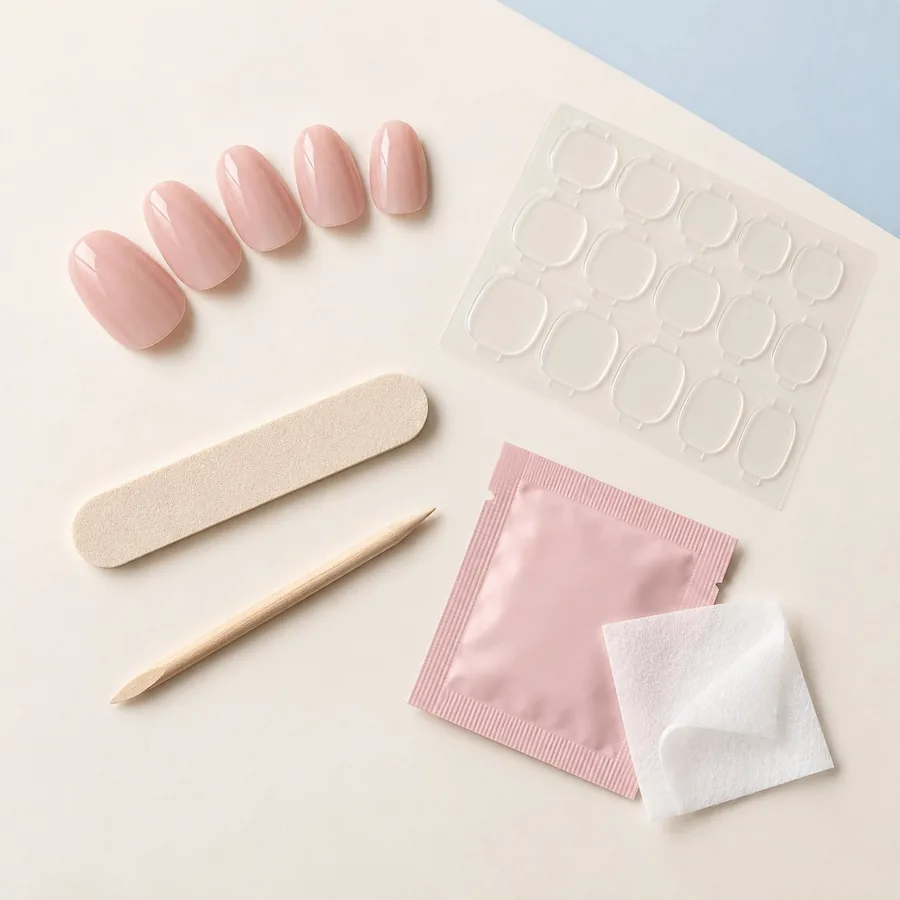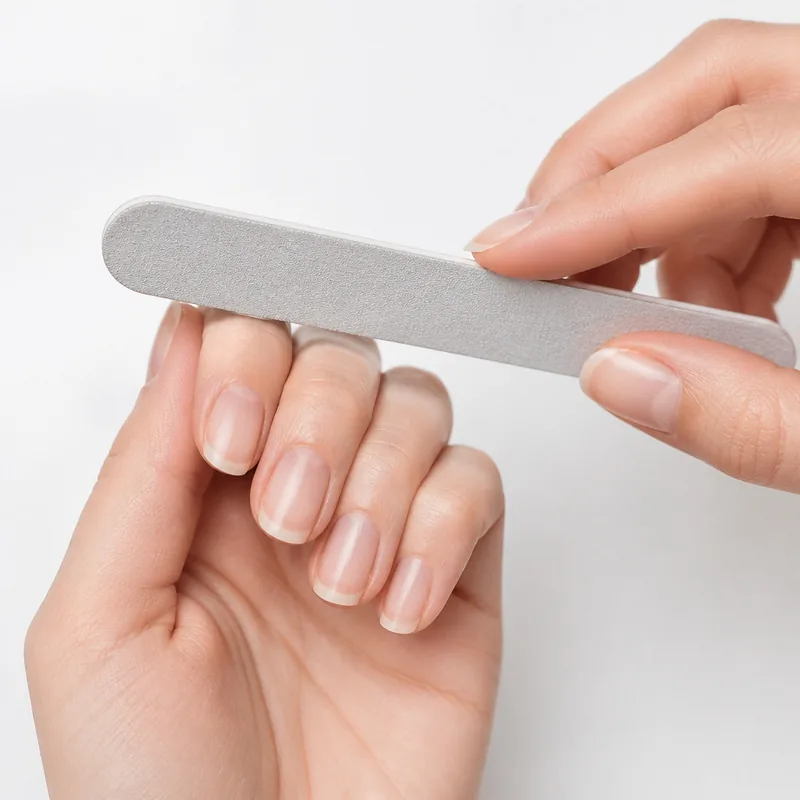
For flat nail beds, compare the underside profile and comfortable contact. Correct width alone does not resolve a curvature mismatch.
Look at the nail from the fingertip
Here, flat describes the relatively shallow curve from one side of the nail to the other. It does not mean the nail has no shape, or that every finger has an identical profile. View your bare nail from its free edge, then compare the underside of a loose press-on from the same direction.
Outline names such as oval, square, and almond do not specify the underside curve. A tapered design can still have a pronounced arch. Doonails acknowledges that some nail shapes do not fit every nail bed and advises trying a different shape when curvature causes discomfort. Its guidance is a reason to compare profiles rather than assume every design shares a mold.
Use a contact check before adhesive
Choose candidates with plausible width first. Set each one over the natural nail in its intended position, keeping its base clear of skin. Follow the maker's dry-fit instructions and distinguish gentle placement from force that changes the cover's shape. Observe the result from above, from the tip, and from the side.
These observations help describe a fit problem; they are not a diagnosis or a precise measurement of curvature. A solid-color cover can hide the center, so avoid assuming full contact solely because its edges appear aligned.
| What you notice | What to compare next |
|---|---|
| Side coverage with visible space underneath | A shallower underside profile |
| Exposed natural nail along the sides | The next suitable width |
| Skin overlap | A narrower candidate or another mold |
| Pinching or sustained pressure needed | A different profile before any attachment |
Ask for the information a width chart cannot show
When contacting a maker, name the exact design and explain what happens in the dry fit: for example, the sides reach your nail edges but a visible space remains underneath. Ask whether a flatter profile or a sizing sample is available. A side or end-view product photo may help compare candidates, although it cannot establish your personal fit.
If the maker offers samples, record the style, size number, apparent contact, and comfort for each finger. Try the adjacent width when appropriate, but avoid concluding that flat nails always need a larger size. A wider cover may simply extend onto skin while retaining the same curve problem.
How to compare press-on nail brands for flat nail beds
Compare the exact product line rather than treating an entire brand as flat-fitting. Doonails notes that curvature can feel uncomfortable on some nail beds. Olive & June’s sizing guidance likewise addresses fitting without forcing the cover. Neither statement proves every style from either brand will fit a flatter nail.
For a shortlist, record the line and shape, available widths, underside profile information, and whether a sample or clear fitting guidance is offered. Ask for an end-view photo if the listing only shows the design from above. Confirm the policy for an unsuitable unused set before ordering; do not assume a fitting trial is returnable.
If no profile measurements or sample are available, record that as an unanswered fit question. A brand comparison can help identify systems and instructions, but it cannot replace the contact check for your own fingers.
Resolve the fit before selecting an adhesive
For conventional glue-on or adhesive-tab press-ons, extra adhesive is not a reliable correction for an unsuitable profile. Do not stack tabs, fill a dry-fit gap with glue, or maintain painful pressure to hold the cover flat. Adhesive selection comes after you have found a compatible cover.
Do not borrow gap-filling instructions from a gel-extension system: those products and application requirements differ. Likewise, avoid heating, bending, or altering a cover unless its own maker supplies a specific method. FDA advises following nail-product instructions and warnings. If discomfort or irritation develops after application, stop using the product and seek appropriate advice; use the specified removal process rather than pulling the nail away.
A few common questions
Are flat nail beds always wide?
No. Width and crosswise curvature are separate characteristics. Check both for each finger.
Will stronger glue make a curved press-on fit?
It does not change the cover's shape. Resolve gaps or pinching during the dry fit before choosing an adhesive.
Can I tell the curve from an almond or square label?
No. Those names describe the outline. Ask about the exact style's profile or compare a sizing sample.
Which press-on nail brand is best for flat nail beds?
We have not tested brands on your nail profile, so we do not name a universal winner. Compare the exact line’s underside curve, width range, and fitting options; a brand name alone does not establish comfortable contact.
Sources & reading notes
This guide explains general considerations. Product labels and instructions vary, so check the specific kit and adhesive you use.
Get to know Kittiva.
Explore the designs and kit details on the brand’s own website. Check current contents and delivery availability before choosing.
Read our Kittiva spotlightThis editorial project supports Kittiva.