Compare compatibility, removal, and your routine first. Treat wear claims as product-specific guidance, never as a promise for every pair of hands.
Which press-on nail adhesive are you choosing?
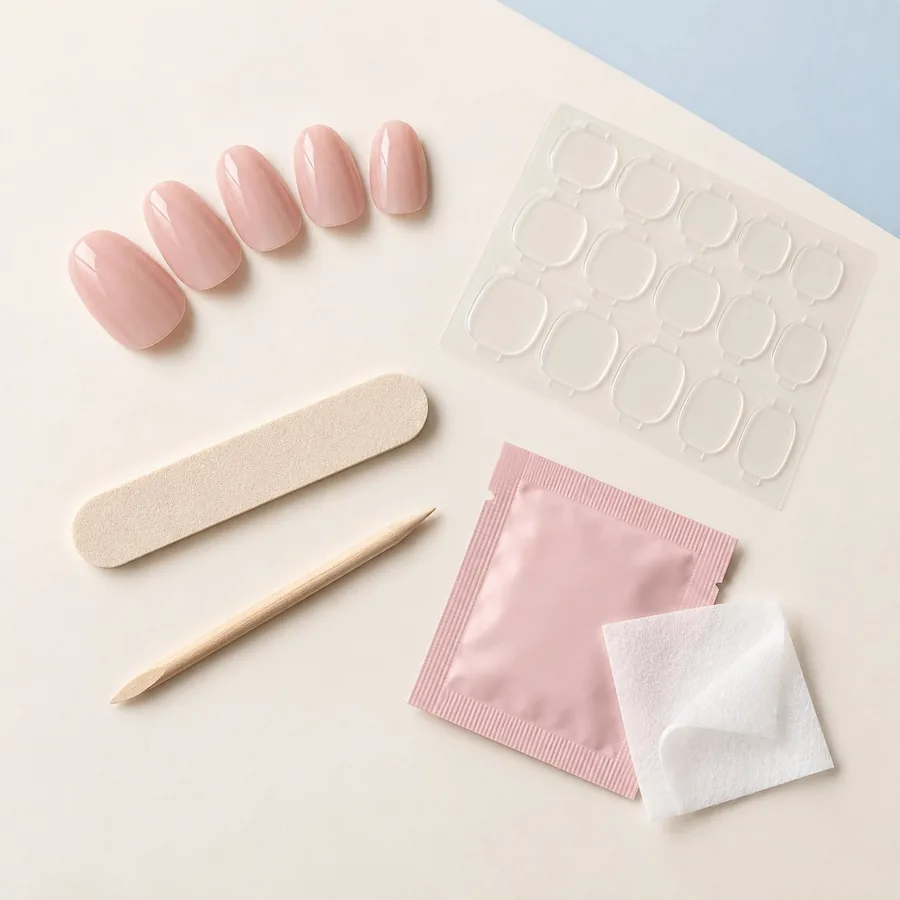
Adhesive is the broader category: it may mean a separate liquid nail glue, adhesive tabs on a sheet, or adhesive already applied to the cover. First identify what your nails are designed to use. A no-glue press-on can still have a sticky backing; it simply avoids a separate liquid-glue application.
A product sold as gel glue may require a curing lamp and belong to a specified extension system. It is not a substitute to add beneath an ordinary decorated press-on. This comparison covers conventional nail glue and tabs; check the actual curing directions and use the UV-kit guide for light-cured systems.
How to choose press-on nail glue that lasts
Start with a glue labeled for artificial nails and permitted by the cover manufacturer. Check the ingredient list and application format together: a brush, precision nozzle, or squeeze tube describes how you dispense the product, not how it ranks against other formulas. Keep household adhesives out of your manicure supplies.
For a documented example, KISS PowerFlex Brush-On Nail Glue lists ethyl cyanoacrylate, triacetin, polymethyl methacrylate, and BHA. Its brush format and published directions identify a particular product; those ingredients are not a promise of comfortable wear or suitability for everyone.
Glamnetic advertises up to two weeks of wear on its Brush-On Nail Glue page. Treat that as the brand’s claim for its system, not a minimum wear time or an independent comparison. We have not tested these glues against one another, so neither example establishes the strongest glue.
- Check fit first: a cover should sit comfortably without rocking or being forced flat. Adhesive cannot correct an unsuitable width or underside curve.
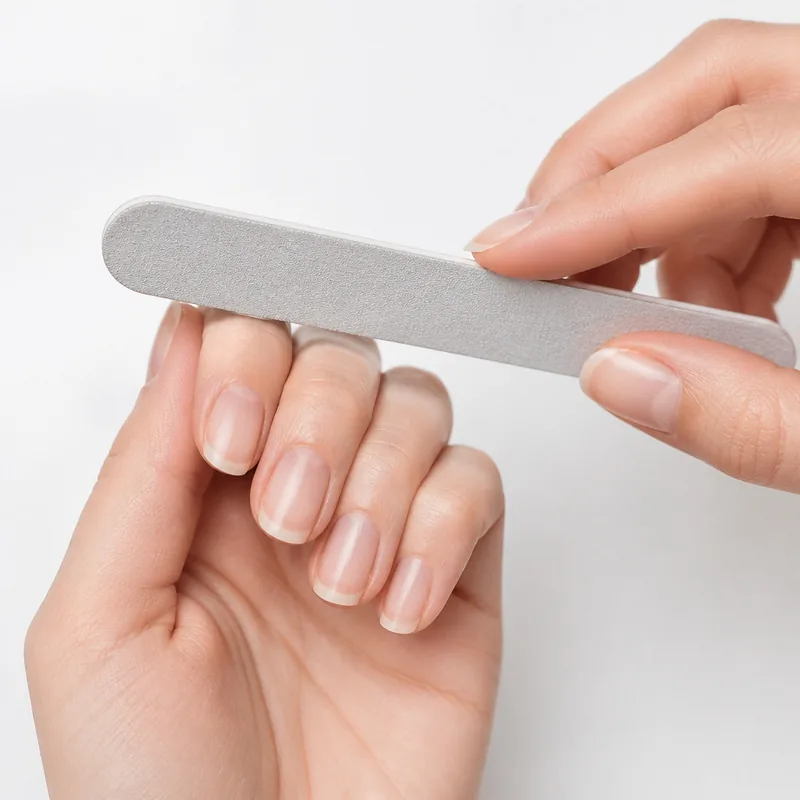
- Follow the exact preparation, placement, glue quantity, and holding instructions. Adding extra glue or more aggressive buffing is not a reliable way to extend wear.
- Read the product’s guidance for water contact and daily activities. Stop treating a wear claim as a target if the nail lifts, becomes uncomfortable, or develops another problem.
- Choose the compatible remover before application. A longer-lasting bond is only useful when you can also follow the removal process.
Compare the whole process
Tabs can make sense when you want to change a look and the product's removal method suits your schedule. Glue may suit a system designed for a more committed application. Actual performance depends on the particular adhesive, fit, preparation, and what you do with your hands.
The label matters more than the category. Different glue formulas and tab designs can have different directions. Check that your press-ons permit the attachment method you have chosen before combining supplies from separate packages.
| Decision | Nail glue | Adhesive tabs |
|---|---|---|
| Application | Measure and place the liquid amount directed | Choose a tab size and position the adhesive layers |
| Fit check | Dry-fit before opening the bottle | Dry-fit the nail and select the tab footprint |
| Removal | Use the glue system's specified method | Use the tab system's specified method |
| Reuse | Check cover and remover compatibility | Check cleaning and fresh-tab instructions |
| Wear expectations | Read that product's guidance | Read that product's guidance |
What is the press-on nail hybrid method?
In its article about the hybrid method, MOONLEE uses the phrase for combining adhesive tabs and liquid nail glue during one application. That explains one use of the term; the name alone does not identify compatible products, a suitable layering sequence, or a removal method for your set.
A box containing both glue and tabs also does not establish that they should be layered. For example, the product-specific instructions for KISS ICON Remarkable describe tabs for the first two wears and glue for the final wear. Those are separate applications, with separate removal directions.
Before considering a combination, identify the exact nails, tabs, and glue, then look for instructions that explicitly cover their use together. A general brand tutorial or a customer review is not confirmation for a different product combination. If the instructions are unclear, ask the maker or choose a documented single-method option.
- Check whether the instructions mean two adhesives in one application or alternative methods for separate wears.
- For an explicitly supported combination, obtain the matching application, aftercare, and removal directions before starting. Do not fill missing steps with a different tutorial.
- Do not infer a longer wear time or easier removal from the word hybrid. Keep any expectations tied to the exact products and their directions.
- The hybrid label does not establish whether a lamp is needed. If an adhesive specifies light curing, use the instructions for that complete compatible system; see the UV-kit guide for the separate curing questions.
Match the method to your routine
Think about when you need the manicure off, how much time you can allow for removal, and whether your work has nail-length or artificial-nail rules. A wedding guest changing looks the next day and someone keeping one style have different practical priorities.
For either method, a cover that does not fit comfortably is a sizing issue. Stronger adhesive is not a solution to a nail that rocks, pinches, or overlaps the skin. Fix the fit before comparing adhesives.
- Check the removal process before deciding on the application process.
- Read water-contact and activity guidance on your exact product.
- Keep the adhesive packaging with your set for later reference.
- Avoid stacking tabs or mixing glue and tabs unless explicitly instructed.
Separate reusability from removal
A press-on being described as reusable does not mean every removal method will preserve it. Solvents can alter certain covers or finishes, and old adhesive may need a product-specific cleaning step. Check both the adhesive directions and the nail maker's guidance.
Plan for fresh adhesive where required. Do not keep a nail attached beyond the product's directions just to preserve the design, and never pull a bonded cover off to save time. If preserving a set requires forcing removal, stop.
Consider your nails and past reactions
Tabs should not be assumed allergy-free, and glue should not be judged only by how firmly it attaches. Read the ingredients and warnings; FDA notes that nail products can cause reactions. A prior adhesive reaction is a reason to ask a clinician about suitability before trying another system.
Skip artificial covers on damaged nails. No adhesive choice turns an existing nail problem into a cosmetic fix.
A few common questions
Are adhesive tabs always safer than nail glue?
There is no universal safety ranking for every person and product. Ingredients, fit, application, and removal all matter; neither method is guaranteed to prevent damage or reactions.
Can I put glue on top of an adhesive tab?
Only combine attachment methods when the makers’ instructions explicitly support the exact products together, including their application and removal. Calling it a hybrid method does not establish compatibility. If the guidance is missing or describes separate wears, use a documented single-method option.
How many days will each method last?
There is no single reliable number. Consult the exact product's wear guidance and remove as directed if the fit or condition changes.
Are nail adhesive and nail glue the same thing?
Adhesive can refer to several attachment formats, including liquid nail glue, separate tabs, and pre-applied adhesive. Identify the exact format and the directions for your nails before selecting a replacement.
Sources & reading notes
This guide explains general considerations. Product labels and instructions vary, so check the specific kit and adhesive you use.
- FDA: Nail Care Products
- AAD: Manicure and pedicure safety
- KISS imPRESS: pre-applied adhesive and application instructions
- KISS PowerFlex: ingredients, brush applicator, and directions
- Glamnetic Brush-On Nail Glue: product-specific wear claim
- MOONLEE: hybrid-method terminology, not evidence of a universal wear advantage
- KISS ICON Remarkable: product-specific instructions for separate tab and glue wears
Get to know Kittiva.
Explore the designs and kit details on the brand’s own website. Check current contents and delivery availability before choosing.
Read our Kittiva spotlightThis editorial project supports Kittiva.